
RF systems
RF repeaters
Repeaters that pick up the signal of a donor base station, amplify it and re-radiate it where coverage is weak: inside buildings, in tunnels and at the edge of a cell. The range includes band-selective RF repeaters, digital ICS repeaters and compact pico boosters.
Key features
- TETRA, GSM, WCDMA, UMTS and LTE bands
- Gain from 65 to 95 dB
- ALC and automatic shutdown
- Isolation check and auto gain control
- Indoor and outdoor housings
- Interference cancellation (ICS)
- Web GUI and NMS monitoring
- Multi-band versions
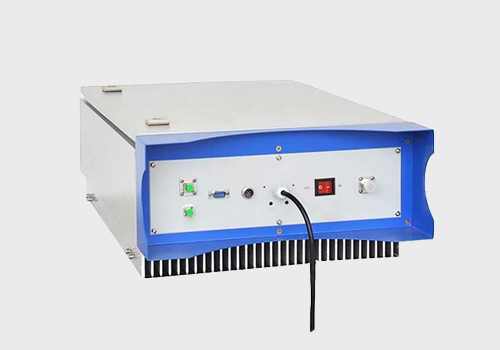
RF repeater, indoor and outdoor
| Parameter | Specification | Remark |
|---|---|---|
| Frequency range | TETRA, GSM, WCDMA, UMTS, LTE | Selected for the project |
| Frequency tolerance | 0.05 ppm | |
| Output power | DL +10 to +37 dBm, UL +10 to +23 dBm | |
| Gain | 65 to 95 dB | Selected for the project |
| Gain flatness | 3 dB | Ripple in band |
| Gain variation over temperature | ± 3 dB | |
| Gain adjustment range | 30 dB in 1 dB steps | |
| ALC range | 15 dB | Automatic level control |
| Transmission delay | ≤ 5 µs | |
| Noise figure | ≤ 7 dB | Uplink at maximum gain |
| Out-of-band gain | Per 3GPP | |
| Functions | Isolation and over-power check, auto gain control, GUI, NMS | Options |
| Power supply | 100 to 240 V AC | DC adaptor |
| Operating temperature | Indoor −20 to +40 °C, outdoor −40 to +55 °C |
Digital ICS repeater
| Parameter | Specification | Remark |
|---|---|---|
| Frequency range | WCDMA, UMTS, LTE | Selected for the project |
| Input level | DL −60 to −30 dBm, UL −55 dBm | |
| Output level | DL +10 dBm, UL +13 dBm | |
| Gain | 75 dB with built-in antenna, 70 dB with external antenna | |
| Gain control range | 30 dB in 1 dB steps | |
| Interference cancellation window | 1 µs | |
| Gain tracking time | 1 s | Target gain ± 1 dB |
| System group delay | ≤ 5 µs | |
| Gain flatness | 3 dB | |
| VSWR | 1.5:1 | |
| Noise figure | ≤ 5 dB | |
| Power supply | 100 to 240 V AC | DC adaptor |
| Operating temperature | −20 to +60 °C | |
| Cooling | Natural convection |
Pico booster, 3G WCDMA
| Parameter | Specification | Remark |
|---|---|---|
| Frequency range | UL 1960 to 1980 MHz, DL 2150 to 2170 MHz | 4 FA (20 MHz) |
| Gain | 60 dB | |
| AGC range | ≥ 25 dB | Output power ± 2 dB |
| Maximum output power | UL ≥ 10 dBm, DL ≥ 10 dBm | |
| Automatic shutdown level | ≥ +13 dBm RMS | Auto recovery |
| Noise figure, uplink | < 6 dB | At maximum gain |
| Group delay | ≤ 6 µs | |
| EVM | < 10 % | Supports HSDPA |
| TX/RX isolation | > 85 dBc | |
| RF connector | SMA female | Donor antenna port |
| Size and weight | ≤ 125 × 90 × 35 mm, ≤ 1 kg | Without bracket |
| Operating temperature | 0 to 50 °C | IP42, indoor |
Three repeater types
A band-selective RF repeater amplifies the uplink and downlink of one operator band. It needs enough isolation between the donor and service antennas, typically 15 dB more than the gain, or it will oscillate. The repeater checks isolation and reduces gain or shuts down automatically when it is too low.
An ICS (interference cancellation system) repeater removes the feedback signal digitally. This allows the donor and service antennas to be mounted close together, which is often the only option on a small site.
A pico booster is a small plug-in unit with a built-in service antenna for a home or a single office. It sets its own gain from the measured isolation.
Applications
Frequently asked questions
How much antenna isolation does a repeater need?
As a rule the isolation between donor and service antenna should be at least 15 dB higher than the repeater gain. With 80 dB of gain, plan for 95 dB of isolation. Where that is not possible, use an ICS repeater.
Do repeaters need approval?
Yes. Repeaters transmit on licensed frequencies, so they need type approval for the market and normally the consent of the network operator. Tell us the country and band and we will confirm what is available.
What is the difference between a repeater and a DAS?
A repeater is one box that re-radiates a donor signal. A DAS distributes the signal from a head end to many antennas over coax or fiber. Large buildings and tunnels usually combine both: a repeater or base station as the source and a fiber DAS for distribution.
Need a band or power level not listed?
Send the frequency, output power and gain you need. An RF engineer reviews it and replies with a datasheet proposal.