
RF systems
RF switches
High power RF switches for routing transmit signals between antennas, amplifiers and test ports. Standard models handle up to 200 W CW with low insertion loss and are driven by TTL logic.
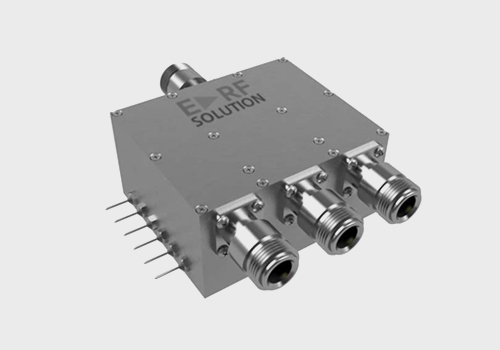
Key features
- DC to 6 GHz
- Up to 200 W CW
- SPST, SPDT and DPDT
- Low insertion loss, high isolation
- TTL driver, variable control voltage
- Fail-safe and latching versions
- Fast switching
- Connector options
Standard models
Click a row to select it for a quote| Select | ||||||
|---|---|---|---|---|---|---|
| ERS50-500P100TSD1 | 50~500 | 100 | 0.6 | 60 | 100 × 80 × 38 | |
| ERS50-500P50TSD1 | 50~500 | 50 | 0.5 | 65 | 100 × 80 × 38 | |
| ERS500-2000P50TSD1 | 500~2000 | 50 | 1 | 60 | 100 × 80 × 38 | |
| ERS1000-2000P100TSD1 | 1000~2000 | 100 | 1 | 60 | 100 × 80 × 38 | |
| ERS1000-3000P100TSD1 | 1000~3000 | 100 | 1 | 40 | 100 × 80 × 38 | |
| ERS2000-3000P100TSD1 | 2000~3000 | 100 | 1 | 40 | 100 × 80 × 38 | |
| ERS2330-2360P200TSD1 | 2330~2360 | 200 | 1 | 80 | 100 × 80 × 38 | |
| No standard model matches these values. Try a wider range, or send a spec request. | ||||||
Reading the switch table
Power handling is the CW power the switch can carry through a closed path. Insertion loss is what the signal loses on that path, and isolation is how far the signal is suppressed at the port that is switched off. For a transmit path, a few tenths of a dB of extra loss turn directly into heat and lost output power, so compare insertion loss first.
A fail-safe switch returns to a defined position when the control voltage is removed. A latching switch stays where it was last set and needs power only while switching. Choose fail-safe for redundancy switching and latching where supply current matters.
Applications
Redundancy switching
Main and standby amplifier changeover in base stations and repeaters.
Antenna switching
Routing one transmitter to several antennas.
Radar and defense
Transmit path routing.
RF test systems
Switch matrices for production test.
Frequently asked questions
What do SPST, SPDT and DPDT mean?
SPST (single pole, single throw) opens or closes one path. SPDT (single pole, double throw) connects one common port to either of two ports. DPDT (double pole, double throw), also called a transfer switch, swaps two paths at once and is used for main/standby changeover.
Can the switch be hot-switched at full power?
Power handling in the table applies to a closed path. Switching while RF power is applied stresses the switch more than carrying it. Tell us if you need hot switching and at what power, and we will recommend a model.
Need a band or power level not listed?
Send the frequency, output power and gain you need. An RF engineer reviews it and replies with a datasheet proposal.