
Power amplifiers
Linear power amplifiers
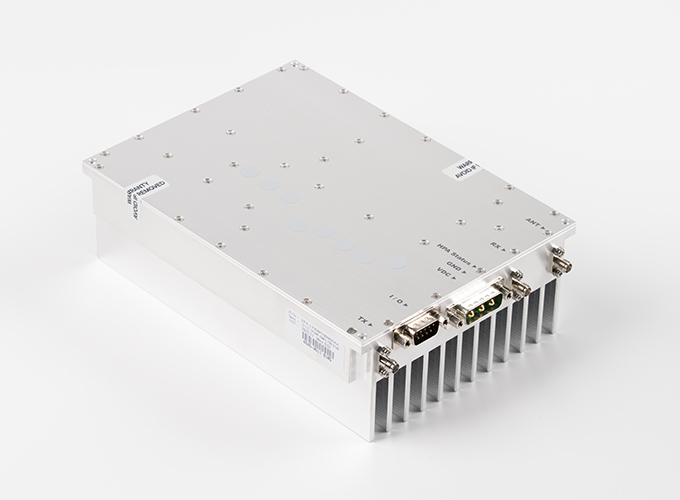
Linear power amplifiers for systems where adjacent-channel leakage matters as much as output power. The ELM series is designed against IMD, ACLR and ACPR limits for TETRA, LTE and 5G NR, and is used in base stations, band-selective repeaters and DAS remote units.
Key features
- Designed against IMD, ACLR and ACPR limits
- Isolator-protected output
- Wide output power range
- Wide operating temperature range
- Compact, rugged housing
- Field-proven reliability
- Standard options available
- Custom bands and power levels
Standard models
Click a row to select it for a quote| Select | Datasheet | ||||||
|---|---|---|---|---|---|---|---|
| ELM-0380-38-45 | 380 | 400 | 38 | 45 | 180 × 150 × 28 | ||
| ELM-0380-39-40 | 380 | 400 | 39 | 40 | 180 × 150 × 28 | ||
| ELM-0380-38-45-B | 380 | 420 | 38 | 45 | 180 × 150 × 28 | ||
| ELM-0390-38-45 | 390 | 410 | 38 | 45 | 180 × 150 × 28 | ||
| ELM-0390-38-45-B | 390 | 410 | 38 | 45 | 180 × 150 × 28 | ||
| ELM-0390-33-45 | 390 | 460 | 33 | 45 | 150 × 180 × 28 | ||
| ELM-0410-38-45 | 410 | 430 | 38 | 45 | 180 × 150 × 28 | ||
| ELM-0450-38-45 | 450 | 470 | 38 | 45 | 180 × 150 × 28 | ||
| ELM-0450-46-45 | 450 | 470 | 46 | 45 | 150 × 180 × 28 | ||
| ELM-0465-38-45 | 465 | 485 | 38 | 45 | 180 × 150 × 28 | ||
| ELM-0490-38-45 | 490 | 512 | 38 | 45 | 180 × 150 × 28 | ||
| ELM-0769-38-45 | 769 | 775 | 38 | 45 | 180 × 150 × 28 | ||
| ELM-0799-38-45 | 799 | 824 | 38 | 45 | 180 × 150 × 28 | ||
| ELM-0851-38-45 | 851 | 869 | 38 | 45 | 180 × 150 × 28 | ||
| ELM-0920-38-45 | 920 | 960 | 38 | 45 | 180 × 150 × 28 | ||
| ELM-0925-43-54 | 925 | 960 | 43 | 54 | 180 × 150 × 28 | ||
| ELM-1805-40-54 | 1805 | 1880 | 40 | 54 | 180 × 150 × 28 | ||
| No standard model matches these values. Try a wider range, or send a spec request. | |||||||
Output power and gain are typical values. See each datasheet for full specifications, connectors and power supply.
Why linearity is specified separately
Modulated signals such as π/4-DQPSK in TETRA or OFDM in LTE and 5G NR have a high peak-to-average ratio. When an amplifier is driven close to saturation, the peaks are compressed and energy spills into the neighbouring channels. Regulators and network operators limit this leakage, so the amplifier has to meet the limit at the rated average power, not only reach the power.
A linear amplifier is therefore rated at an output level where it still meets the distortion requirement. When you compare models, compare the output power at your ACLR or IMD limit and your signal type.
What to send us for a linear design
For a custom linear amplifier we need the signal type and bandwidth, the number of carriers, the linearity limit in dBc with its measurement offset, and the average output power at which the limit applies. With those values we can tell you whether a standard ELM model fits or what a new design would look like.
Applications
Frequently asked questions
What do IMD, ACLR and ACPR mean?
IMD (intermodulation distortion) is measured with two or more CW tones and reported in dBc. ACLR (adjacent channel leakage ratio) and ACPR (adjacent channel power ratio) compare the power that leaks into the neighbouring channel with the power in the wanted channel, using the real modulated signal. LTE and 5G NR specifications use ACLR; TETRA and CDMA documents usually say ACPR.
Which standard models are used for TETRA?
The ELM models that start at 380 MHz cover the TETRA bands. Use the frequency filter above the table to list them, then check the datasheet for the rated power at the TETRA ACPR limit.
Can a high power amplifier be used with back-off instead?
Sometimes. Backing off a saturated amplifier improves linearity, but efficiency drops and the result depends on the signal. A purpose-built linear amplifier is usually smaller and more efficient at the same linearity.
Need a band or power level not listed?
Send the frequency, output power and gain you need. An RF engineer reviews it and replies with a datasheet proposal.